Nonprofit Digital Strategy: What It Is & How to Build Yours




A strong digital presence is no longer optional for contemporary nonprofits.
According to M+R Benchmarks, online fundraising revenue increased by an average of 15% from 2024 to 2025, with several nonprofit verticals seeing even larger gains. And with email subscriber lists, digital ad spend, and social media followership increasing across the nonprofit sector, your organization needs to make itself stand out in this crowded landscape.
Successfully creating a digital presence that increases cause awareness and support requires a strategic approach. In this guide, you’ll learn everything you need to know to develop a solid nonprofit digital strategy, including:
- Nonprofit Digital Strategy FAQ
- Components of a Nonprofit Digital Strategy
- How Tech Impact Can Help With Your Nonprofit’s Digital Strategy
Let’s get started by diving deeper into what digital strategy is and why it matters for your organization.
Nonprofit Digital Strategy: Frequently Asked Questions
What Is A Nonprofit Digital Strategy?
A nonprofit digital strategy is a unified approach to leveraging technology and communications to support broad organizational goals. It helps your nonprofit use the right tools and methods to reach the right audiences with the right messages that help further your mission.
Many organizations think of digital strategy as simply having a website, social media presence, or email list. However, this conception conflates digital strategy with digital marketing strategy, which is just one part of an aligned approach to technology use and communication that influences every area of your operations and strategic plan.
Why Is Digital Strategy Important For Nonprofits?
A thoughtfully crafted and effectively executed digital strategy can benefit your nonprofit in many ways, including:
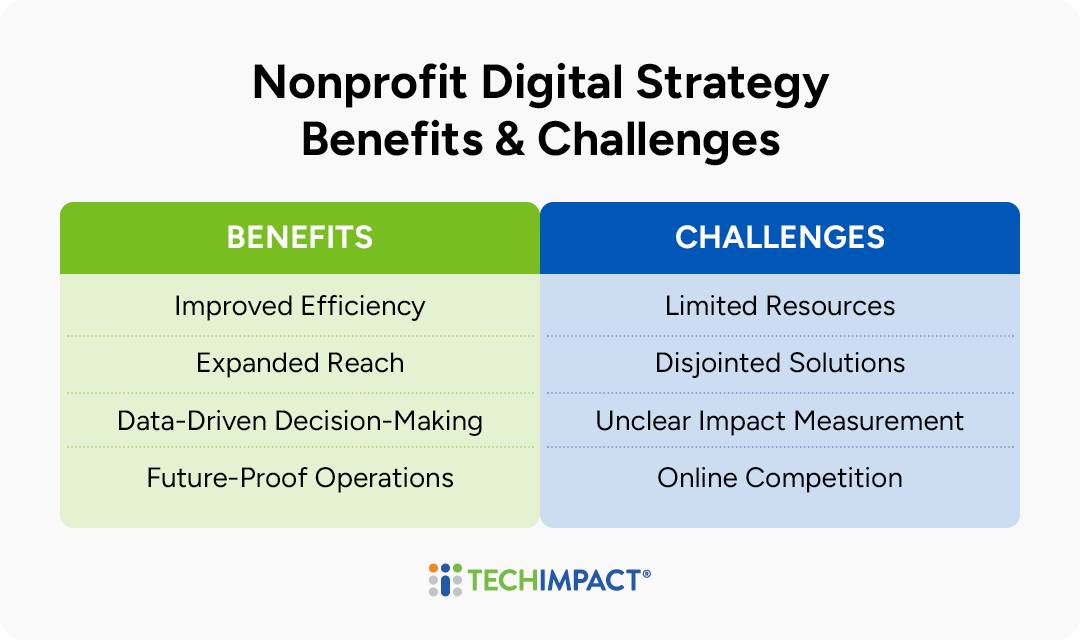
- Improving efficiency, since intentional technology usage can save time and resources for your team while producing better results (especially when automation is involved).
- Expanding your organization’s reach to new audiences who could either support your cause or benefit from your programming.
- Enabling data-driven decision-making through unified insights into whether your approach is working and how to move forward accordingly.
- Future-proofing your operations by keeping your organization at the forefront of innovation in the sector and aligning with modern community members’ expectations.
Your nonprofit will only fully experience these advantages if your digital strategy is tailored to your unique goals and audience, which is why upfront research and continuous monitoring are essential for success.
What Challenges Do Nonprofits Commonly Face When Developing Digital Strategies?
In addition to having different objectives and target audiences from other nonprofits, your organization will likely run into its own set of hurdles when developing your digital strategy, such as:
- Limited resources to invest, whether in terms of staff time, technical knowledge, or budget for marketing and software.
- Disjointed solutions that each perform limited functions and don’t automatically share data with your nonprofit’s other platforms.
- Unclear impact measurement, which makes it difficult to understand your strategy’s actual impact on your mission.
- Online competition, since many other nonprofits in your area and vertical are likely also developing their digital presence (not to mention all of the other webpages, ads, emails, text messages, and social media posts your supporters probably see each day).
Before you dive into digital strategy creation, it’s helpful to assess your nonprofit’s current technology and marketing approach. This way, you can more easily understand your unique areas for improvement, strengths to capitalize on, and opportunities for innovation that you could take advantage of in the process.
Components of a Nonprofit Digital Strategy
Your nonprofit’s digital strategy will consist of many elements that work together, meaning developing and executing it will most likely be a team effort. Let’s walk through the individual components to give you a better understanding of how to put them into action at your nonprofit.
Goals
Every successful nonprofit initiative begins with clear goals, and digital strategy development is no exception. Depending on your organization’s overarching objectives, your digital goals may be related to mission awareness, supporter engagement, revenue generation, program impact, administration, or other areas of your operations. You might also set more than one goal, although pursuing too many at once can dilute your efforts and overwhelm your team, so you may hit a limit eventually.
No matter what type or how many goals you set, they should all follow the SMART method, meaning they’re:
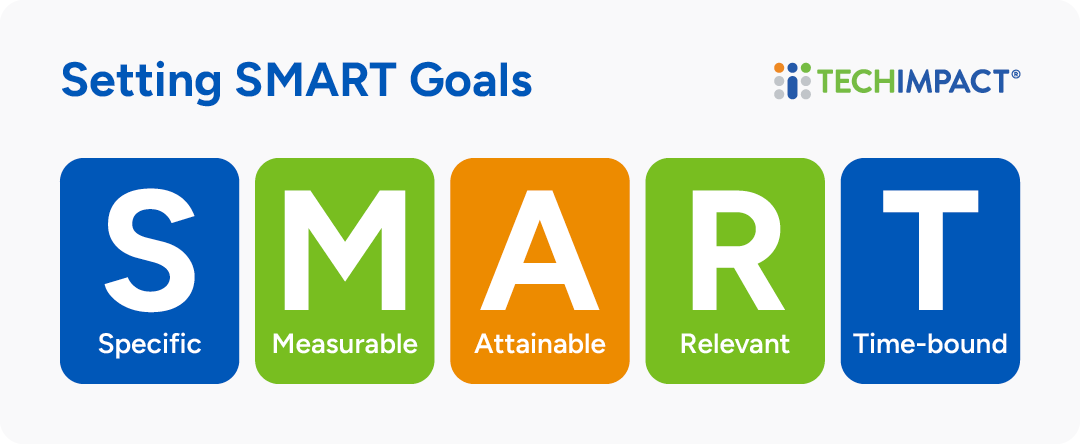
- Specific about what you hope to accomplish
- Measurable, with a numerical target attached to them
- Attainable based on your team’s current capacity and past performance, as well as broader sector trends
- Relevant to your organization’s overarching goals
- Time-bound by a clear deadline
For example, your nonprofit might set a goal “to increase revenue brought in via our online donation page by 10% over the next calendar year.” This goal is specific about what you want to achieve, includes a metric and timeline, and is likely relevant to an overarching goal of raising more funds for your mission.
To determine whether your goal is attainable, start by looking at past online donation page revenue data. If the most recent year-over-year increase in that number was 8%, and you also know that your organization is on a growth trajectory, a 10% boost may strike the right balance between pushing your team while remaining within reach.
Audience
For your communications and technology deployment to effectively engage your audience, you first need to understand who you’re trying to connect with through your digital strategy. You probably won’t have just one audience you’re talking to in this process—instead, you may be reaching a group that includes:
- Supporters: This audience can be further broken down into donors, volunteers, event attendees, advocacy campaign participants, and other individuals who contribute in different ways to your mission (and there is likely some overlap between groups).
- Beneficiaries: Depending on your cause, you may connect directly with individuals who receive your services or with people in close proximity to your beneficiaries (for example, animal shelters primarily speak to pet adopters in their messaging, and nonprofits that serve children usually communicate with their parents and guardians).
- Other stakeholders: This group may include grantmakers, corporate sponsors, charity watchdog groups, regulatory agencies, and governments, all of whom can make or break how your organization operates.
All of these audiences will become even more granular as you dig into their demographics, psychographics, and past interactions with your nonprofit. This nuance is why thorough audience research is critical for developing a strategy that resonates with your unique recipients.
Brand
Your nonprofit’s brand is the way it represents itself to all of its audiences. A consistent brand builds credibility and makes your organization more recognizable and memorable for everyone who interacts with it.
When most people think about branding, visual aspects of a brand are usually what come to mind first—logos, color schemes, typography, graphic styles, etc. However, branding also includes messaging elements that range from your nonprofit’s mission statement and tagline to the tone, word choices, and stylistic elements that feature in your written content.
As you develop your digital strategy, consider how all of these components work together to tell your nonprofit’s audience who you are and what you stand for. Then, determine whether you need to change any aspects of your brand or just want to make sure what you have is used consistently, and compile a digital style guide of these elements for your team’s reference.
Storytelling
Storytelling is essential for getting your audience to care about your cause. While branding establishes a foundation of credibility, storytelling builds an emotional connection on top of it that is often the push they need to take a desired next action.
The stories you tell should highlight how your nonprofit solved a problem while remaining true to what actually happened (i.e., don’t invent details in an attempt to make your organization look better). It’s usually best to focus on one main character, who can be a staff member, supporter, or beneficiary—as long as you get their permission to share their name, photo, and perspective first.
Some audience members will be more moved by logic than emotion, so pairing stories and impact data is often helpful. For example, an animal shelter may start a donor thank-you email by noting that supporters’ contributions allowed that organization to find homes for more than 200 pets over the previous year. Then, the message might tell the story of one rescue cat that came to the shelter in a particularly rough situation but is now thriving with its adoptive family to put the number into perspective.
Marketing
Although marketing isn’t everything when it comes to your nonprofit's digital strategy, it’s still an important component. Different digital marketing channels are better suited to different types of messaging, so leveraging multiple methods is most effective for spreading the word about your work while also creating more touchpoints for audiences.
Website: Best for hosting explanatory content, blog posts, and submission forms.
Email: Best for sending recurring newsletters and making longer announcements.
Text Messaging: Best for communicating quick updates and reminders.
Social Media: Best for networking and encouraging two-way communication.
Digital Ads: Best for attracting brand-new audiences to your work.
Need help incorporating these channels into your nonprofit's digital strategy?
Additionally, contrary to popular belief, print marketing is not dead. However, your paper flyers and direct mail messages should align with your digital strategy by maintaining the same brand standards and encouraging audiences to take the next step by visiting your website.
Technology
Technology fuels every aspect of your digital strategy’s execution, from drawing audiences in to helping them take the next step and tracking data. Review your nonprofit’s tech stack to make sure it includes the following platforms:
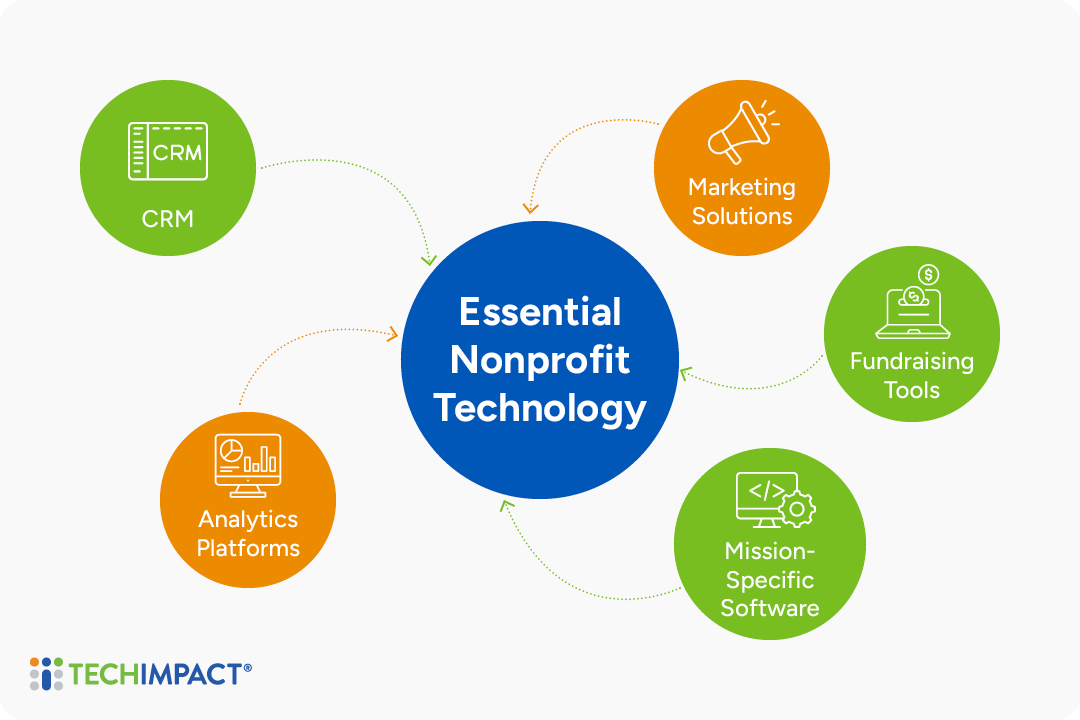
- A constituent relationship management (CRM) system that keeps data on all of your nonprofit’s supporters and stakeholders in one place.
- Marketing solutions ranging from a website builder and graphic design tools to platforms that help automate emails, texts, and social media posting.
- Fundraising tools for donation processing, event planning, crowdfunding, and any other revenue-generating activities your nonprofit engages in.
- Mission-specific software if your nonprofit needs unique tools to manage its programs or services (e.g., an inventory management system for a nonprofit thrift store).
- Analytics platforms, which may be powered by predictive artificial intelligence (AI) for more in-depth visualizations and insights.
Additionally, try to adopt platforms that integrate with each other. This way, data will transfer automatically between platforms, saving your team time and reducing the risk of errors associated with manual entry and data silos.
Governance
Data entry mistakes aren’t the only risk your organization may face while developing its digital strategy. To cover all of your bases in this process, you should:
- Develop organizational policies to govern staff and volunteer technology usage, AI implementation, donor data privacy, and other areas where issues may crop up.
- Follow all laws regarding data collection and processing that apply to your nonprofit based on its location and vertical—for example, nonprofits operating in California have to comply with the California Consumer Privacy Act (CCPA), and healthcare organizations are often subject to the Health Insurance Portability and Accountability Act (HIPAA).
- Implement software cybersecurity protocols like limited user permissions, encryption, and two-factor authentication, then train staff on best practices for maintaining security and responding to breaches.
These measures will help your nonprofit not only create an effective digital strategy, but also make sure it holds up under scrutiny and keeps sensitive information safe as you communicate and innovate.
Metrics
Tracking metrics is the best way to understand whether your nonprofit is achieving its goals and how you can adjust your digital strategy over time to make it even better. Some helpful data points to monitor include:
- Marketing conversions: What percentage of individuals who interact with a promotional message perform the intended next action as a result?
- Website traffic: How many visitors find your website during a specific time period, and which pages do they engage with most
- Form completions: How many people who start filling out an online form submit it?
- Open and click-through rates: When audience members receive an email or text message, what percentage of recipients read it, and how many click the links in it?
- Impressions vs. interactions: How many individuals see your social media posts and digital ads, and what percentage of that group engages with the content by clicking the ad or liking, commenting on, or sharing the post?
- Revenue generation: How much money do different online fundraising campaigns and vehicles bring in?
- Administrative efficiency: How much staff time and organizational resources have been saved as a result of technology?
You don’t need to track all of these metrics at all times, and there may be others that are relevant to your strategy as well. The important thing is to collect and analyze the data that is most useful for your organization’s current priorities.
How Tech Impact Can Help With Your Nonprofit’s Digital Strategy
Because digital strategy unifies marketing and technology, it’s helpful to work with a partner that understands the nuances of both in a nonprofit context. Enter Tech Impact, a nonprofit and national leader in technology services and training.
Tech Impact started out as an information technology consulting organization but has since expanded to encompass many aspects of nonprofit tech, including digital strategy via our Message Agency division. Our digital services include:
Comprehensive strategy development, from goal-setting and audience research to content creation and analytics.
Branding to help match your visuals and messaging to your nonprofit’s identity.
Website design using open-source platforms that ensure flexibility, compliance, and accessibility.
CRM implementation and integration for improved data storage and sharing.
Ongoing support and training so your strategy can succeed long-term.
Working with a nonprofit-specific technology consultant is one thing, but partnering with another nonprofit that understands the importance of digital strategy for your organization and the sector's challenges firsthand is another. With Tech Impact, you get the latter—and it’s hard to beat our pricing, too! We’ve supported more than 10,000 nonprofits since our founding in 2003, and we’re ready to help your organization leverage technology to advance social impact next.
Wrapping Up: Additional Resources on Nonprofit Technology
Digital strategy is an ongoing practice of testing, learning, and refining your approach to support your mission over time. Use the tips above to get started, and remember that you can always reach out for expert help from Tech Impact’s Message Agency division when you need it.
For more information on nonprofit technology, check out these resources:
Microsoft 365 for Nonprofits: A Complete Tool Breakdown. Discover a suite of solutions that can support every aspect of your digital strategy, from data storage to marketing.
How to Make Cybersecurity for Nonprofits a Team Priority. Dive deeper into why cybersecurity matters and how to safeguard your data as you build a digital strategy.
Nonprofit Data Migration: Steps for a Smooth CRM Transition. Explore the process of moving your nonprofit’s information and operations from one CRM system to another.